Mara sells a forty-page workbook on pricing for freelance illustrators. She has sold it on a marketplace for two years, at £20 a copy, and on the morning this story starts she was looking at her yearly payout report with a cup of tea going cold beside her.
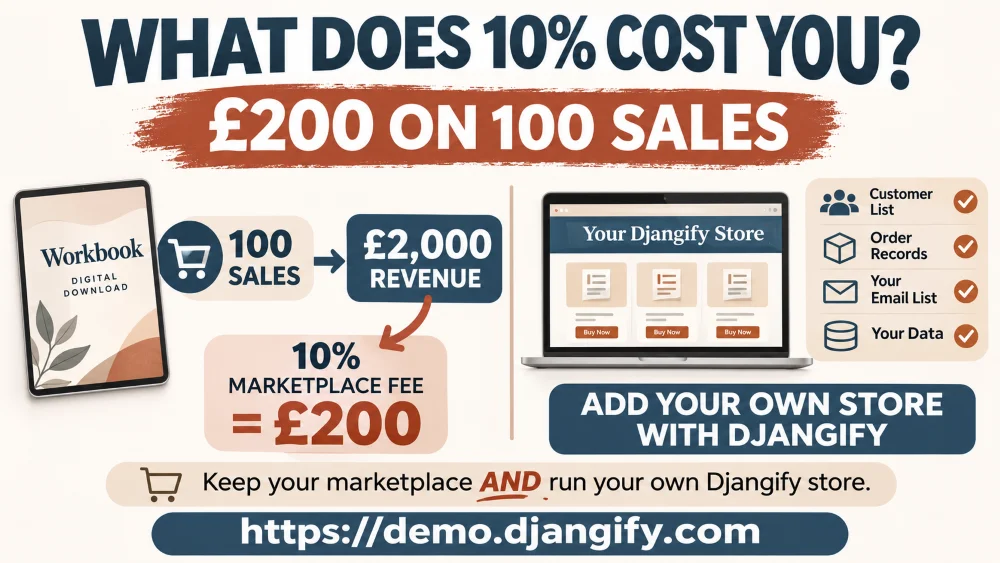
The report said she had sold 100 copies. She did the sum in her head, which is how most of us find out about money. A hundred copies at £20 is £2,000. The marketplace keeps 10%. She had known that number since the day she signed up, but she had never multiplied it by anything. Ten percent of £2,000 is £200, and that was before payment processing, which on some marketplaces comes on top.
£200 was two months of her broadband and a good chunk of her yearly software bill. She did not think the marketplace had cheated her. She just wanted to know what she was actually buying with that cut.
Mara is made up. The sums and the features in this story are real.
- A 10% fee on 100 sales of a £20 product is £200 a year, and the figure grows with every sale.
- Staying on a marketplace and running your own site at the same time is an option, not a break-up.
- Marketplaces have rules about steering their buyers elsewhere, so read your seller terms before you change anything.
- Your own site has costs too, and at 100 sales the saving is close to what hosting costs.
- The saving grows when you sell more or sell the same product to people who found you yourself.
The sum she had never done
Mara opened a blank page and wrote three rows. If 100 sales cost her £200, what do 300 cost? What do 1,000 cost? She had a feeling the answer would be unpleasant, and it was. The figures are below, all at £20 a copy and a 10% fee, before any payment processing.
| Copies sold | Revenue | Fee at 10% | What you keep |
|---|---|---|---|
| 100 | £2,000 | £200 | £1,800 |
| 300 | £6,000 | £600 | £5,400 |
| 1,000 | £20,000 | £2,000 | £18,000 |
None of this means the fee is unfair. It means the fee is a cost that rises in step with her success, and she had been treating it as background noise.
What the fee was actually buying
She tried to be fair about it and wrote down what the marketplace had given her for that £200. The list was not short. It had brought strangers to her listing who had never heard of her. It handled payment and delivery. Buyers trusted the name above her product, and that trust had cost her nothing to earn.
Then she wrote down what she did not have, and that list was just as honest. She did not know who bought the workbook. She could not write to anyone who liked it and offer them the next one. She could not change the rules she sold under, and the marketplace could change them without asking her. On many marketplaces you get paid and never learn who bought from you. If the account were closed one day, there would be little she could do about it.
That second list bothered her more than the £200. The money was a number. The missing customers were the business.
She did not have to leave
Her first thought was that she would have to pack up and move, which sounded exhausting and a little reckless. Then she looked at how other sellers handle it and found that plenty of them do not move at all. They add. The marketplace stays as one place where people find the workbook. A site of their own becomes the main home, and the people who come from their own email list, blog, videos or social accounts are sent there instead.
One door. Every sale comes through the marketplace, the fee is taken each time, and Mara knows nothing about her buyers.
Two doors. The marketplace still brings strangers. Her own Djangify site handles everyone who arrives through her own channels, and the customer list, the order history and the email list belong to her.
On her own site Djangify takes no commission and no per-sale cut. She pays Stripe's normal payment fee and her hosting, and nothing else. Checkout, secure delivery, customer accounts, a blog and newsletters all sit in one system with no plugins to keep updated. When a customer buys, the order and the email address are hers.
Where the rules get in the way
Before she touched anything, Mara read the seller terms of her marketplace from top to bottom. She was glad she did. This part matters, and it applies to you as much as to her.
Marketplaces write rules about what sellers may say to their buyers and where they may send them. Many forbid steering a buyer who found you there to buy elsewhere, putting your own web address inside a listing or a product file, or messaging a buyer outside the marketplace to move the sale. Some also have rules about pricing the same product for less on another site. The rules differ and they change.
This is not legal advice. Read your own marketplace's seller terms, and ask the marketplace if a rule is unclear.
What Mara settled on was to keep the two audiences apart. People who find her on the marketplace buy from the marketplace, exactly as before. People who come from her own email list, her blog, her videos or her social accounts go to her own site. She does not move a marketplace buyer's email address onto her list, and she does not tell marketplace buyers that her own site exists unless the terms clearly allow it. Her own site grows from her own audience, which she is entitled to send wherever she likes.
That arrangement costs her nothing she had before. It does not ask the marketplace to do anything. It simply stops her from relying on one door.
What her own site would cost her
She also checked what her own site would cost. Managed Hosting starts at £9.99 a month on the Lite plan or £17 a month on the Full plan, with free access on both so you can try it first. A year of Lite comes to about £120. Self-Hosted is a one-time £197 for the software, and she would choose and pay for her own server on top.
She put that beside her £200 and saw something most posts like this leave out. At exactly 100 sales a year, the saving is about the size of a year of hosting. Her own site does not make her richer on day one. It starts to pay for itself when she sells more, when she sells the same workbook again and again to people who found her directly, or when she adds a second product to the same site. It also gives her something the fee never did, which is a list of people she can write to.
You may reach a different answer. Test it with the Fee Calculator on this demo, then with the cost calculators on the main site:
Work out your own numbers
Mara wrote her three numbers on a sticky note. Write yours below. They stay in this browser and nothing is sent anywhere.
Your three numbers
- How many copies do you sell in a year?Check your last twelve months of payout reports.
- What is your usual price?Use an average if you have several products.
- What percentage does your marketplace keep, including any processing fee?Multiply the three together to see what you paid last year.
Then she scored how much of her business was rented and how much was hers. It took a minute. It is worth taking, because the answer is rarely the one you expect.
How much of your business do you own?
- I know the names and email addresses of most of my buyers.
- I can write to my buyers without anyone's permission.
- If my main account were closed tomorrow, I would still have somewhere to sell.
- I decide my own prices and my own terms.
- My product pages sit on a site I control.
- Mostly rentedYour business depends heavily on someone else. Start by collecting email addresses you are allowed to keep.
- A mixYou own part of it. Look at which of the five you could move towards your own site first.
- Mostly yoursYou hold most of the keys. Keep your records tidy and your backups current.
Every box on this page is a content block. The free ones are explained, with a prompt for each, in this free article. The reflect boxes and the self check above are premium blocks, available in Djangify Content Blocks Premium.
Questions
Do I have to leave my marketplace?
No. Many sellers keep selling there and run their own site beside it. Read your seller terms so the two do not collide.
Does Djangify take a cut of my sales?
No. Djangify takes no commission and no per-sale cut. You pay Stripe's normal payment fee and your hosting.
Can I start on Managed Hosting and move later?
Yes. A full-site backup and CSV exports mean your data comes with you if you later choose Self-Hosted.
Is my own site for physical products?
No. Djangify is built for digital products, services and events. It is not for physical products with shipping and it is not a marketplace with many sellers.
- A 10% fee on 100 sales of a £20 product is £200, and it rises with every sale.
- Running your own site beside a marketplace is an addition, not a departure.
- Read your marketplace's seller terms before you point any buyer elsewhere.
- Compare the fee with real hosting costs before you decide.
- The bigger prize is owning your customer list, not the £200.
Selling Digital Products Without Platform Fees
How the ownership model works in practice.
Read more →Walk through a real checkout, with a test card
This demo runs the same software you would use to run your own site. Register, add something to your cart, pay with a test card and open your downloads. Nothing is charged.
Visit the demo shop →